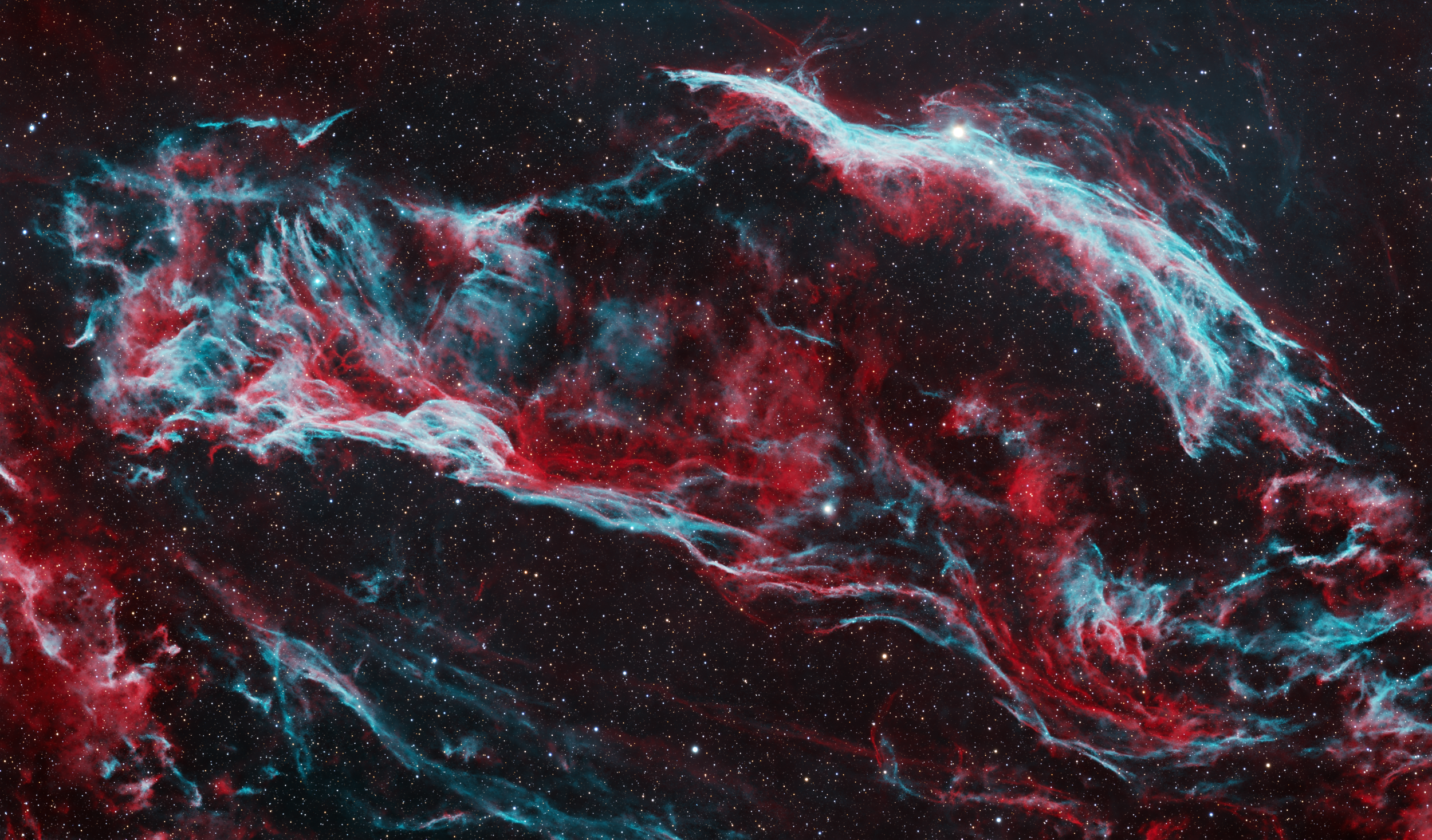
Western Veil Nebula
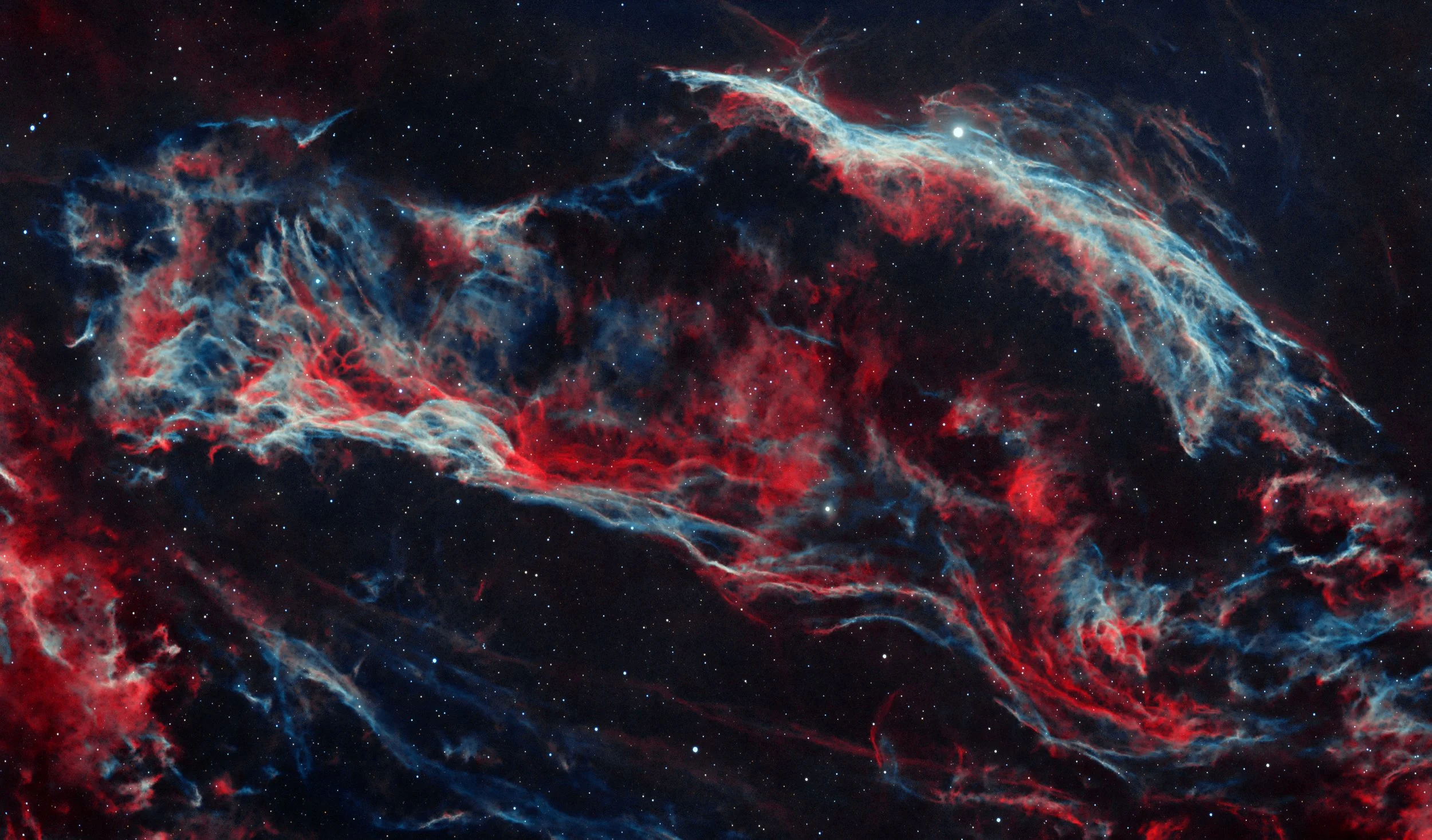
The Western Veil Nebula (NGC 6960) and Pickering's Triangle (NGC 6979/6992) are two prominent portions of the Cygnus Loop, a vast supernova remnant located approximately 2,000 light-years from Earth in the constellation Cygnus. The enormous shell was created when a massive star exploded thousands of years ago, sending a shock wave racing outward through the surrounding interstellar medium. As this expanding shock front encounters clouds of gas and dust, it compresses and heats the material, causing it to glow in intricate sheets, filaments, and delicate strands. The Western Veil is particularly recognizable for the bright filament that passes directly in front of the star 52 Cygni, while Pickering's Triangle forms a complex network of wispy, intertwined filaments extending through the eastern portion of the remnant.
This image is presented in HOO, with hydrogen-alpha (Ha) mapped to red and oxygen III (OIII) mapped to blue and green, while separate RGB data are used to preserve the natural colors of the stars. The different emission lines reveal distinct physical conditions within the expanding supernova shock. Hydrogen traces the extensive regions of ionized gas surrounding the shock front, while oxygen highlights areas where the shock has reached particularly high temperatures and excitation energies. The resulting contrast between the red hydrogen structures and blue oxygen filaments emphasizes the layered and three-dimensional nature of the expanding remnant.
The Cygnus Loop is a remarkable example of how the violent death of a star can reshape its surroundings long after the original explosion has faded from view. What appears as delicate, almost lace-like filaments in an astronomical image are actually enormous clouds of shocked gas spanning hundreds of light-years. The intricate structures visible in the Western Veil and Pickering's Triangle provide a snapshot of a stellar explosion still interacting with the interstellar medium thousands of years after the event itself.
The Veil Nebula is also one of the finest emission nebulae for visual observation, with its appearance changing dramatically depending on telescope aperture, magnification, and filters used. Under dark skies, portions of the Cygnus Loop can be detected with small telescopes, but a wide field of view is particularly valuable for tracing its enormous, curved structure. Moderate- and large-aperture telescopes reveal progressively finer filaments and branching structures, while lower magnifications allow multiple sections of the remnant to be viewed together. A UHC filter provides a dramatic increase in contrast by suppressing much of the surrounding starlight and transmitting the nebula's principal emission lines, while an O III filter is particularly effective as the Veil emits strongly in doubly ionized oxygen. Under dark skies, an O III filter can transform the nebula from a faint, difficult-to-see glow into a remarkably detailed network of luminous filaments, making the Veil one of the most rewarding targets for filtered visual observing.
Data were collected from:
- Estes Park - B3/B4
Integration:
R: 30x120s (1hr)
G: 30x120s (1hr)
B: 30x120s (1hr)
Ha: 80×180s (5hr)
Oiii: 80×180s (5hr)
Total: 13hr
Equipment:
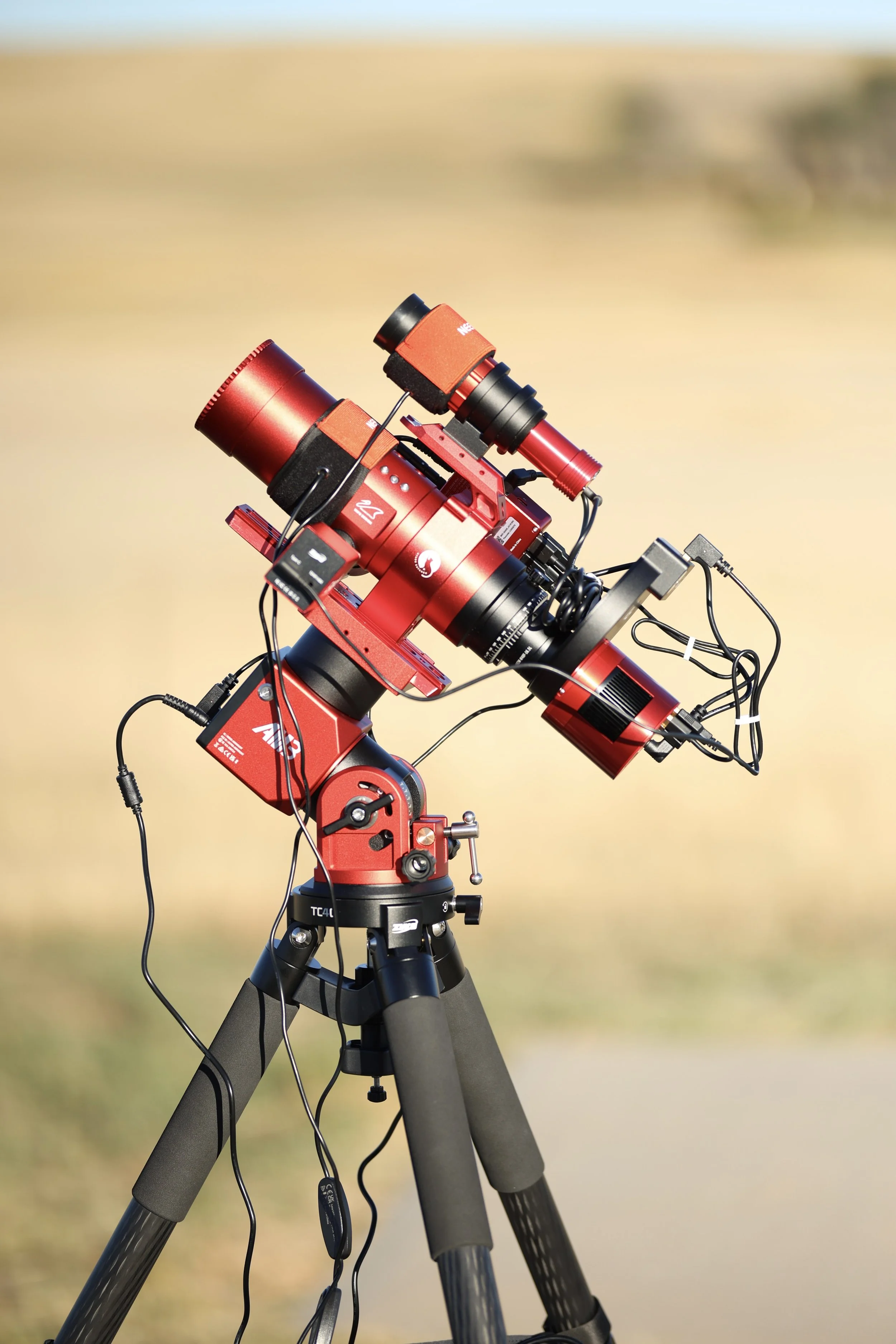
Telescope: William Optics RedCat51
Camera: ZWO ASI585MM Pro Monochrome CMOS camera
Mount: ZWO AM3
Filters: Broadband RGB, 7nm Narrowband Hydrogen-Alpha, and Oxygen-iii
Stacked and processed entirely in Pleiades Astrophoto PixInsight