Bode’s & Cigar Galaxies
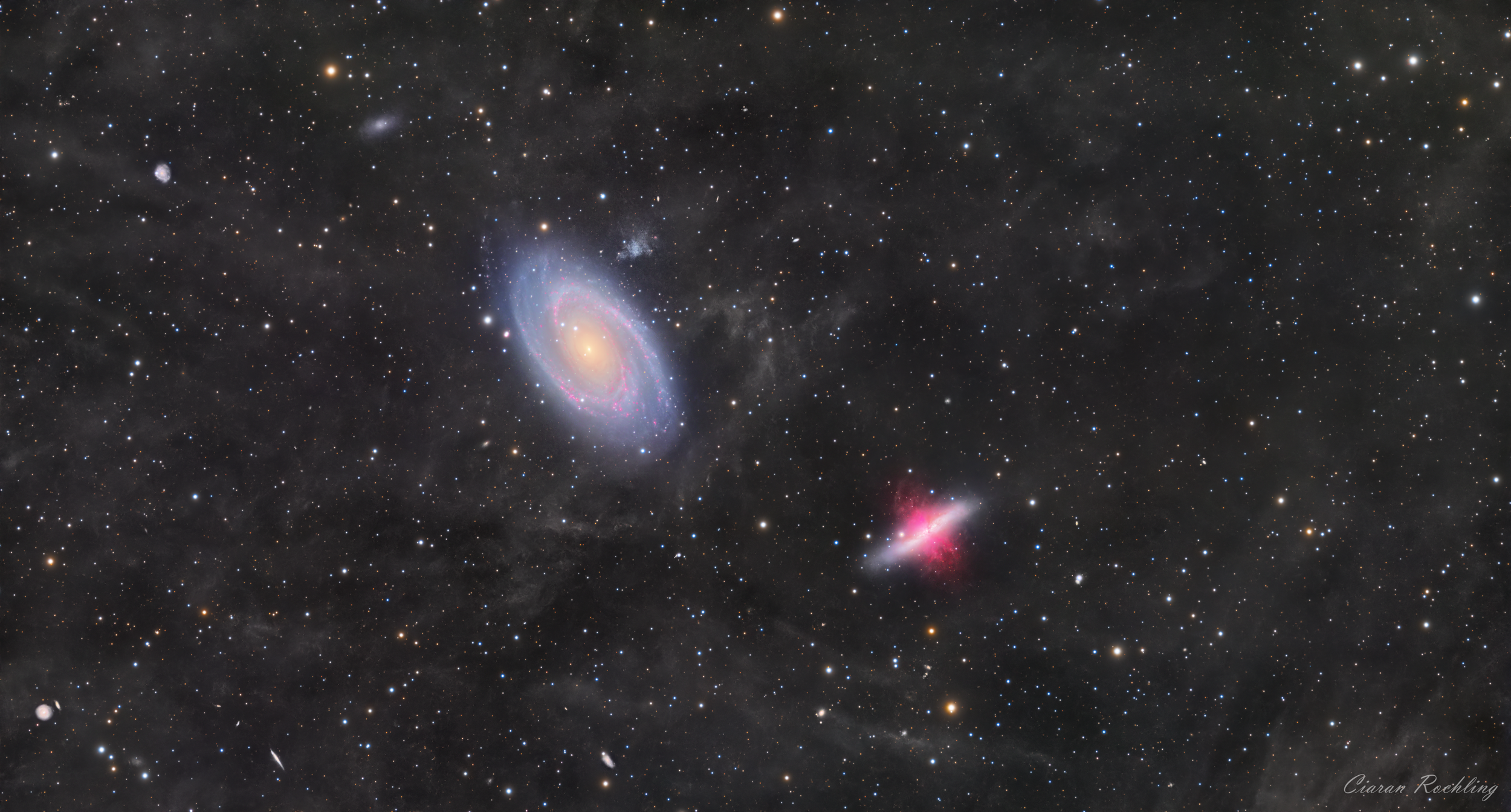
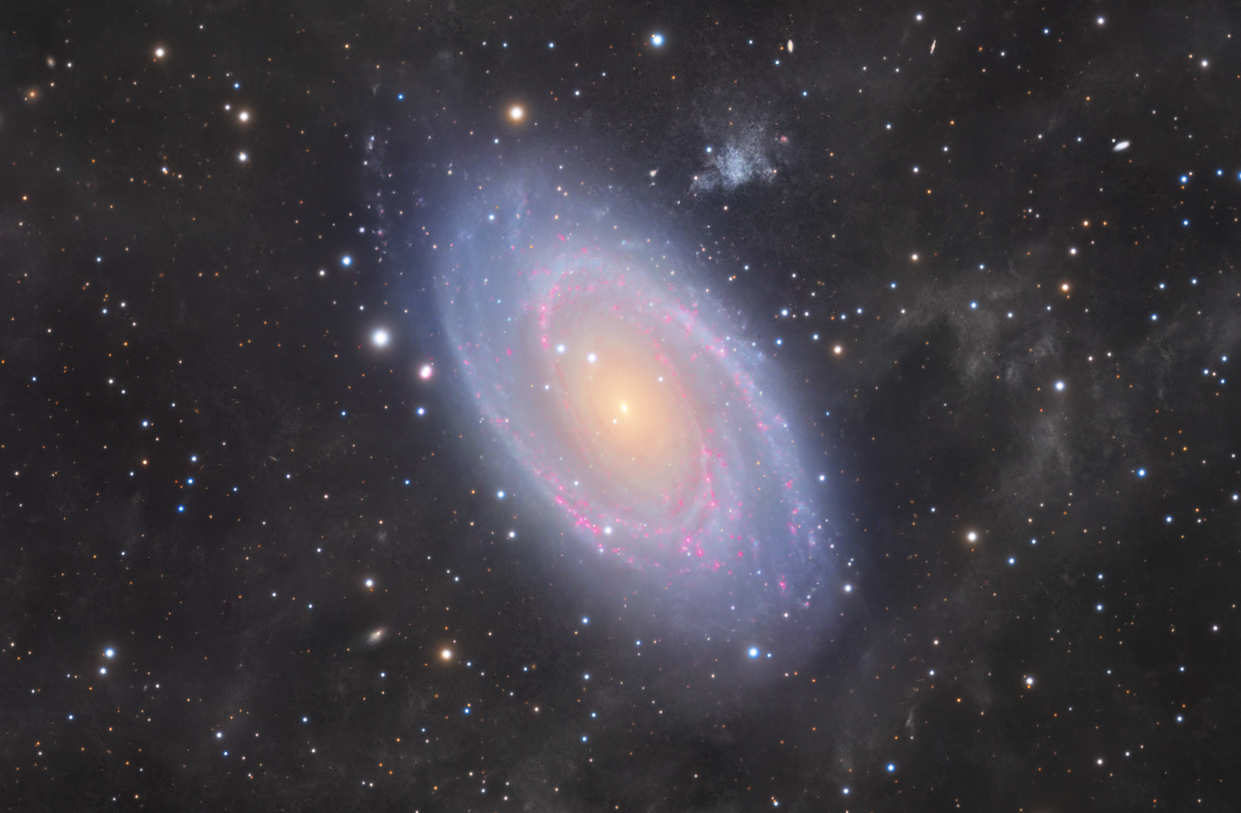
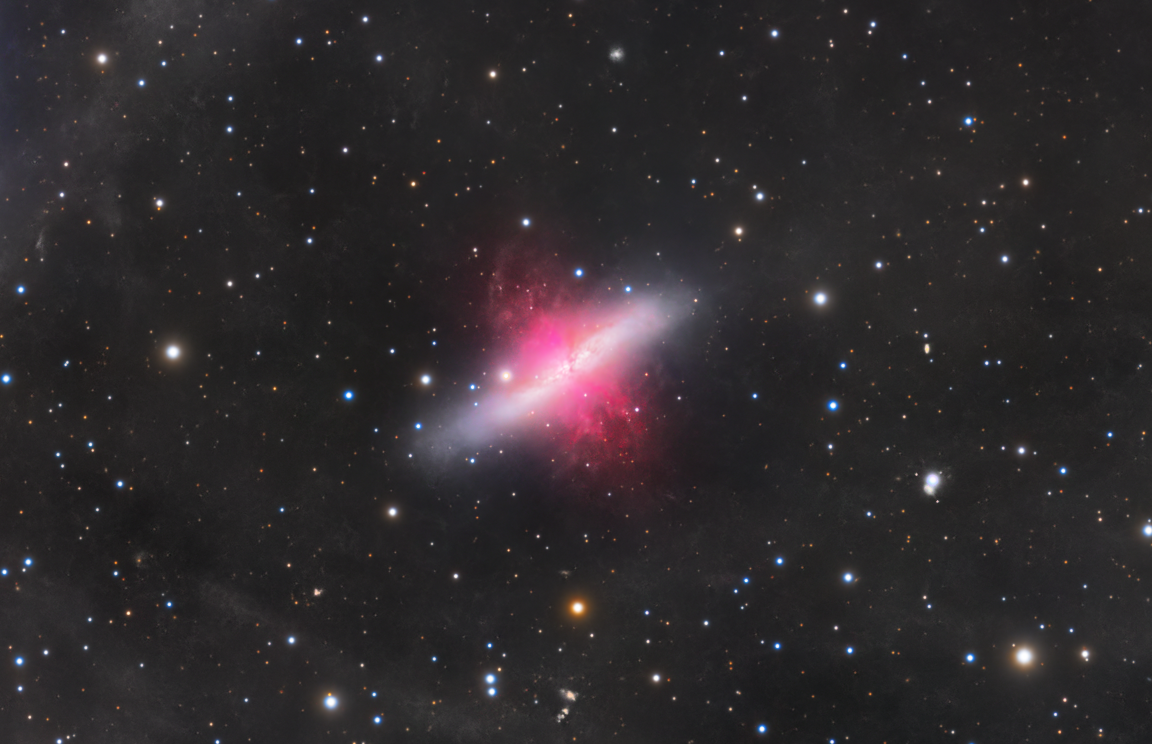
Messier 81 (M81), also known as Bode’s Galaxy, and Messier 82 (M82), the Cigar Galaxy, are a pair of interacting galaxies located approximately 12 million light-years away in the constellation Ursa Major. This high galactic latitude field of view offers a rare glimpse beyond the obscuring dust and stars of the Milky Way, revealing not only these two prominent galaxies but also a vast background of distant galaxies stretching billions of light-years into the universe.
M81, visible on the left side of the image, is a grand-design spiral galaxy with well-defined spiral arms and an active galactic nucleus. In contrast, M82 on the right is an irregular starburst galaxy whose chaotic appearance is likely the result of a past gravitational interaction with M81 hundreds of millions of years ago. This encounter compressed vast reservoirs of gas and triggered an intense period of star formation within M82, causing stars to form at nearly an order of magnitude higher rate than in our own Milky Way. The result is the prominent red hydrogen-alpha emission extending vertically from the galaxy’s core, perpendicular to the galactic plane. This enormous structure, composed primarily of ionized hydrogen gas, is expelled from the galactic plane by powerful stellar winds and supernovae generated by the galaxy’s extreme rate of star formation.
Although these galaxies are visible through modest amateur telescopes under moderate skies, long-exposure astrophotography reveals details far beyond what can be observed visually. The faint red hydrogen regions surrounding M81 and M82 are examples of extragalactic nebulae. Vast clouds of ionized gas associated with active star-forming regions within these distant galaxies. Capturing these structures requires many hours of narrowband imaging, as the emission is incredibly faint compared to the brightness of the galaxies themselves.
Surrounding the galaxies throughout the image is the Integrated Flux Nebula (IFN), a collection of extremely faint interstellar dust clouds located outside the main plane of the Milky Way. Unlike traditional nebulae that are illuminated by nearby stars, the IFN is illuminated by the combined light of billions of stars within our galaxy. Its extreme faintness makes it one of the most challenging structures to capture, requiring dark skies, careful processing, and many hours of exposure. Although this image was not captured under the darkest possible conditions, subtle details and hints of color within the IFN are visible throughout the field. To appropriately color IFN would require dozens of hours of individual RGB data under world class dark skies.
This image represents approximately 54 hours total HaLRGB integration captured over multiple weeks and from several locations. Broadband luminance and RGB data were acquired from Boulder, Colorado, while narrowband hydrogen-alpha data was captured from Omaha, Nebraska, allowing otherwise unusable city-lit imaging time to contribute valuable data.
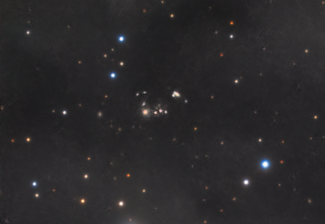
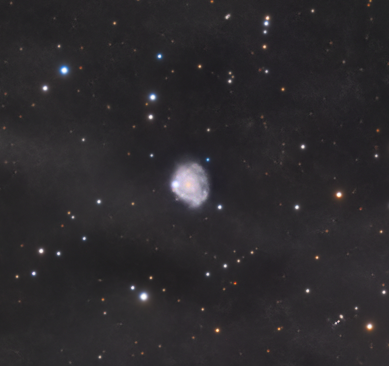
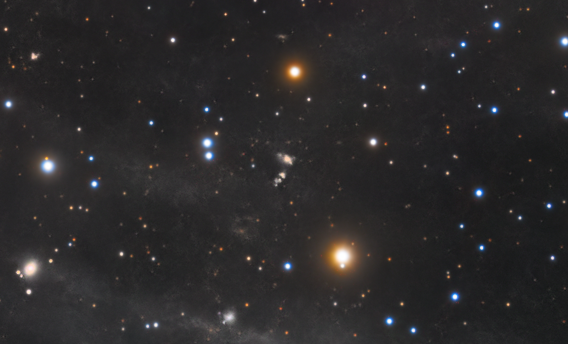
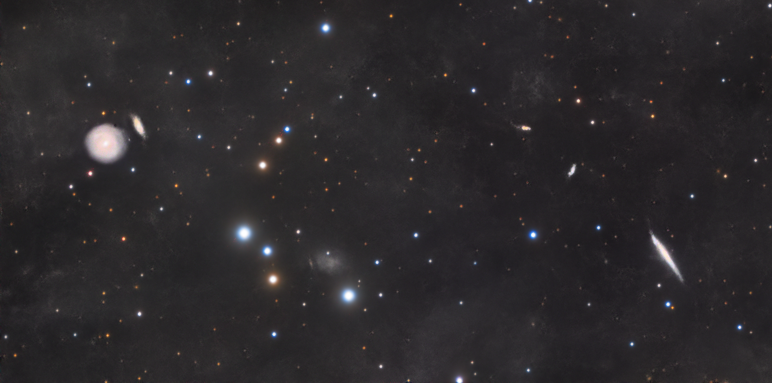
Because this region lies well above the plane of the Milky Way, relatively little foreground dust and stellar obstruction interfere with our view. Many of the faint points of light scattered throughout the image are not stars within our own galaxy, but distant galaxies or galaxy clusters containing billions or even trillions of stars. Some exhibit recognizable shapes and structure despite their immense distance, providing a humbling reminder of the scale, age, and complexity of the universe surrounding us. Below are a collection of 4 crops focused on background galaxies. The left images highlight extremely distant galaxy clusters while the right two highlight intermediate distance galaxies. As you can see, even with only 250mm focal length and 51mm diameter aperture, the intermediate distance galaxies have some identifiable structure.
Data were collected from:
- Boulder - B4/B5
- Omaha - B9
Integration:
Ha: 553×180s (26h39m)
L: 886×60s (14h46m)
R: 136x120s (4hr32m)
G: 123x120s (4hr6m)
B: 126x120s (4hr12m)
Total: 54h15m
Equipment:
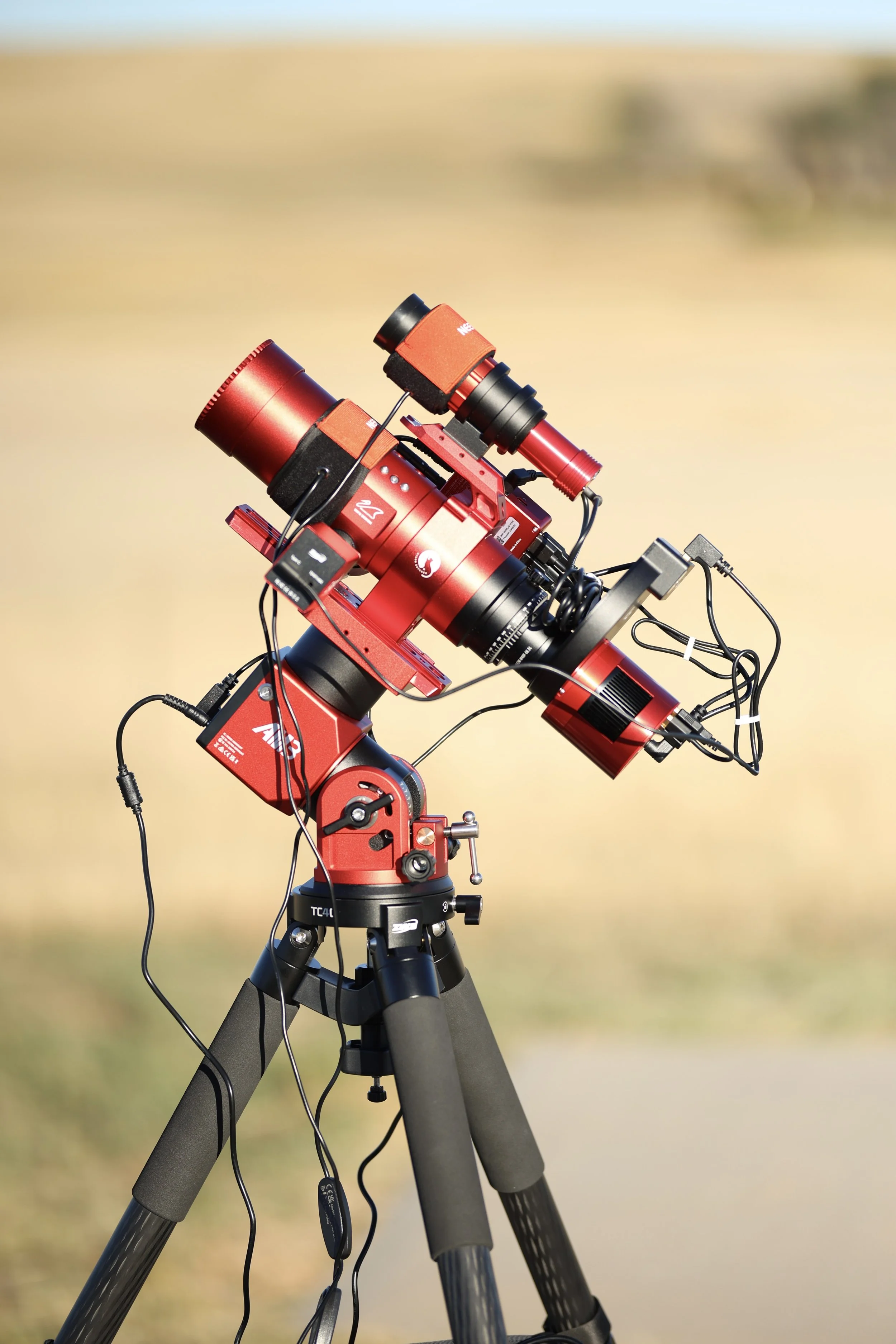
Telescope: William Optics RedCat51
Camera: ZWO ASI585MM Pro Monochrome CMOS camera
Mount: ZWO AM3
Filters: Broadband LRGB, 7nm Hydrogen-Alpha
Stacked and processed entirely in Pleiades Astrophoto PixInsight