Cygnus Wall
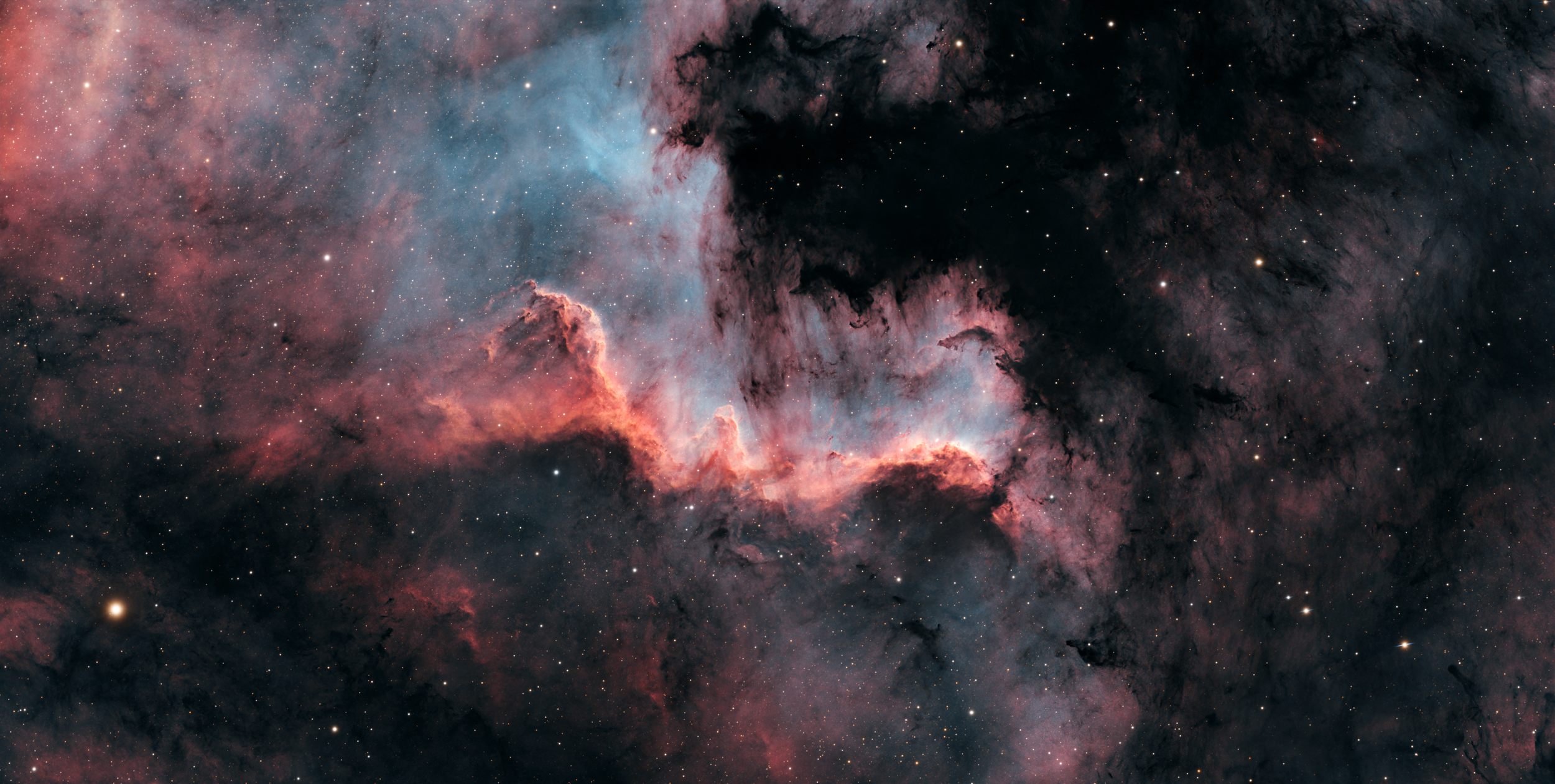
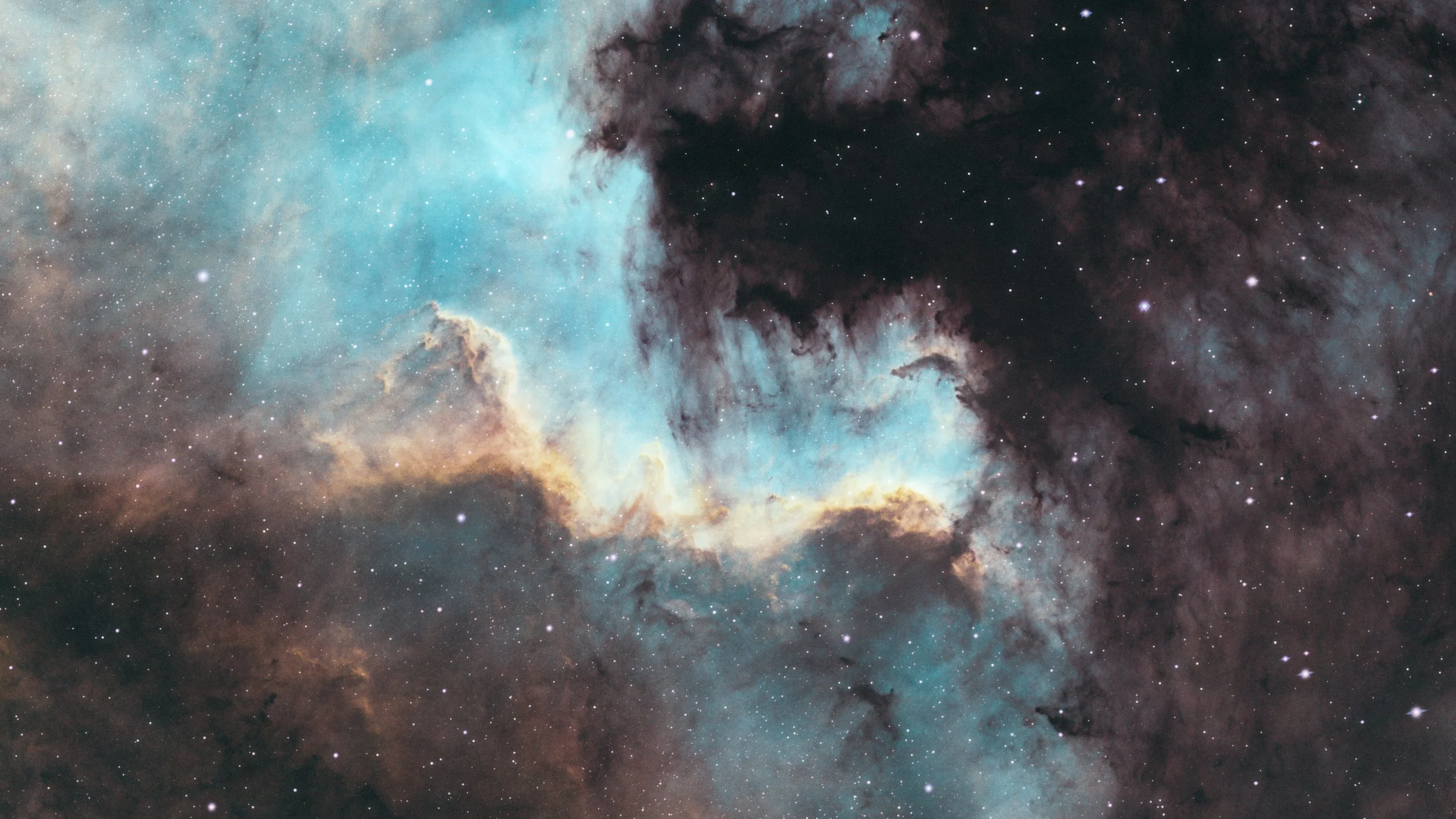
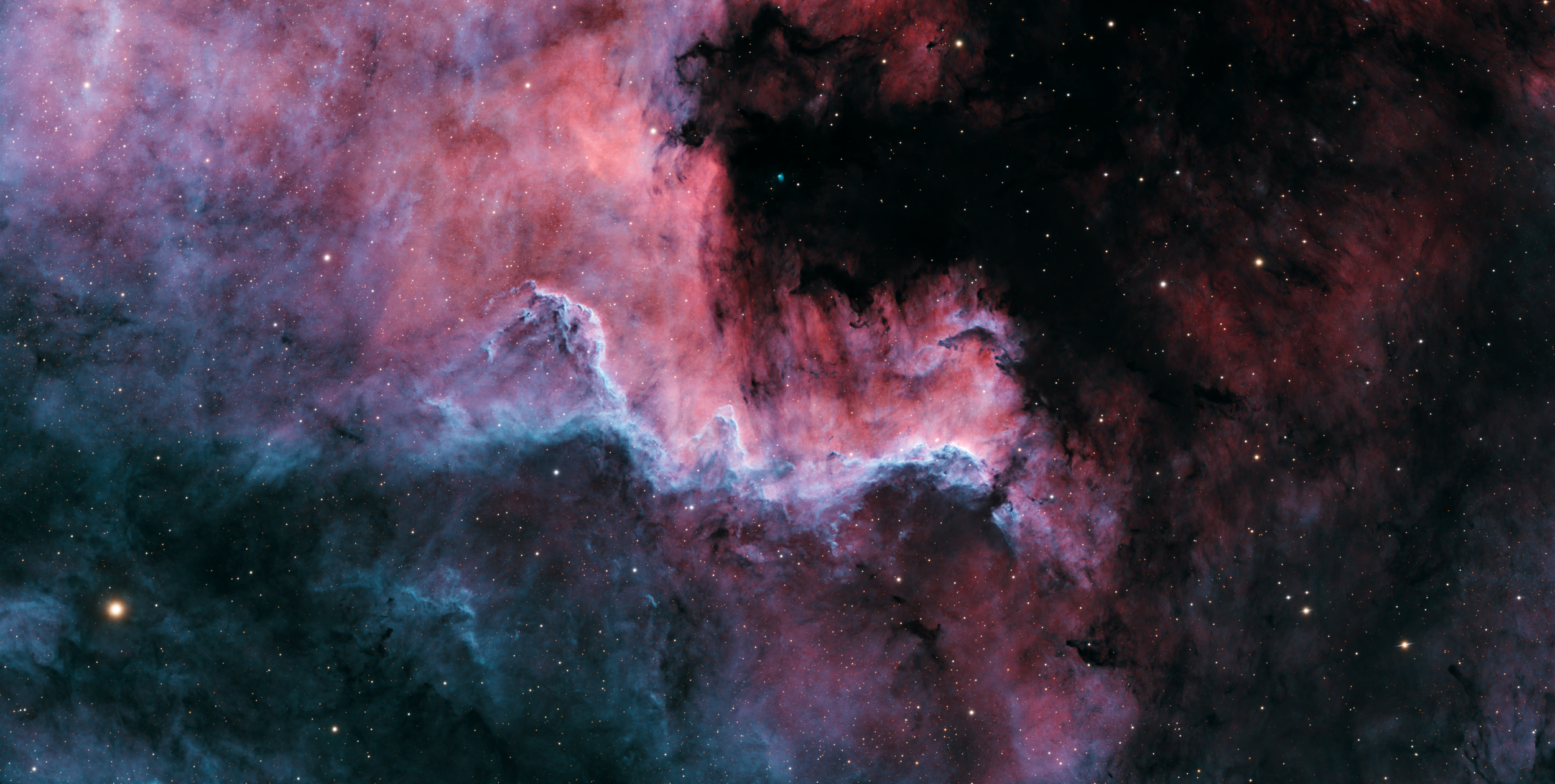
The Cygnus Wall is one of the most dramatic structures within the North America Nebula (NGC 7000), an enormous emission nebula located approximately 2,600 light-years away in the constellation Cygnus. The Wall itself is a dense, highly structured region of gas and dust where intense radiation from nearby young, massive stars is sculpting the molecular cloud. Ultraviolet radiation strips electrons from hydrogen atoms, creating a glowing ionized region, while powerful stellar winds compress and erode the surrounding material. The resulting ionization fronts, ridges, pillars, and dark molecular clouds mark the boundary between the exposed, energized gas and the colder material deeper within the cloud. Within these dense regions, gravity is continuing to collapse pockets of gas and dust, making the Cygnus Wall an active environment for the formation of new stars.
The three images presented here use the same underlying narrowband SII, Ha, and OIII dataset, but each employs a different color mapping: OHS, HSO, and the traditional SHO Hubble Palette. Although the underlying data are identical, changing the assignment of each emission line dramatically alters the way the structure is perceived. Oxygen III, which traces some of the more highly ionized and energetic regions, can bring sharp inner edges and illuminated cavities forward in an image. Hydrogen-alpha provides a broad view of the extensive ionized gas, revealing the large-scale architecture of the Wall, while sulfur tends to emphasize denser, cooler regions and the intricate boundaries surrounding ionization fronts. By changing the palette, these different layers can be visually separated and emphasized, giving the same physical dataset a different sense of depth and morphology.
Under truly dark skies, the broad outline of the nebula can be seen with the naked eye. With sufficient darkness and well-adapted vision, the distinctive shape of the Cygnus Wall can be traced within NGC 7000, including its characteristic curved or “hook” shape. Careful observation can reveal subtle variations in brightness and dark lanes throughout the region, providing a surprising sense of three-dimensional structure even without optical aid.
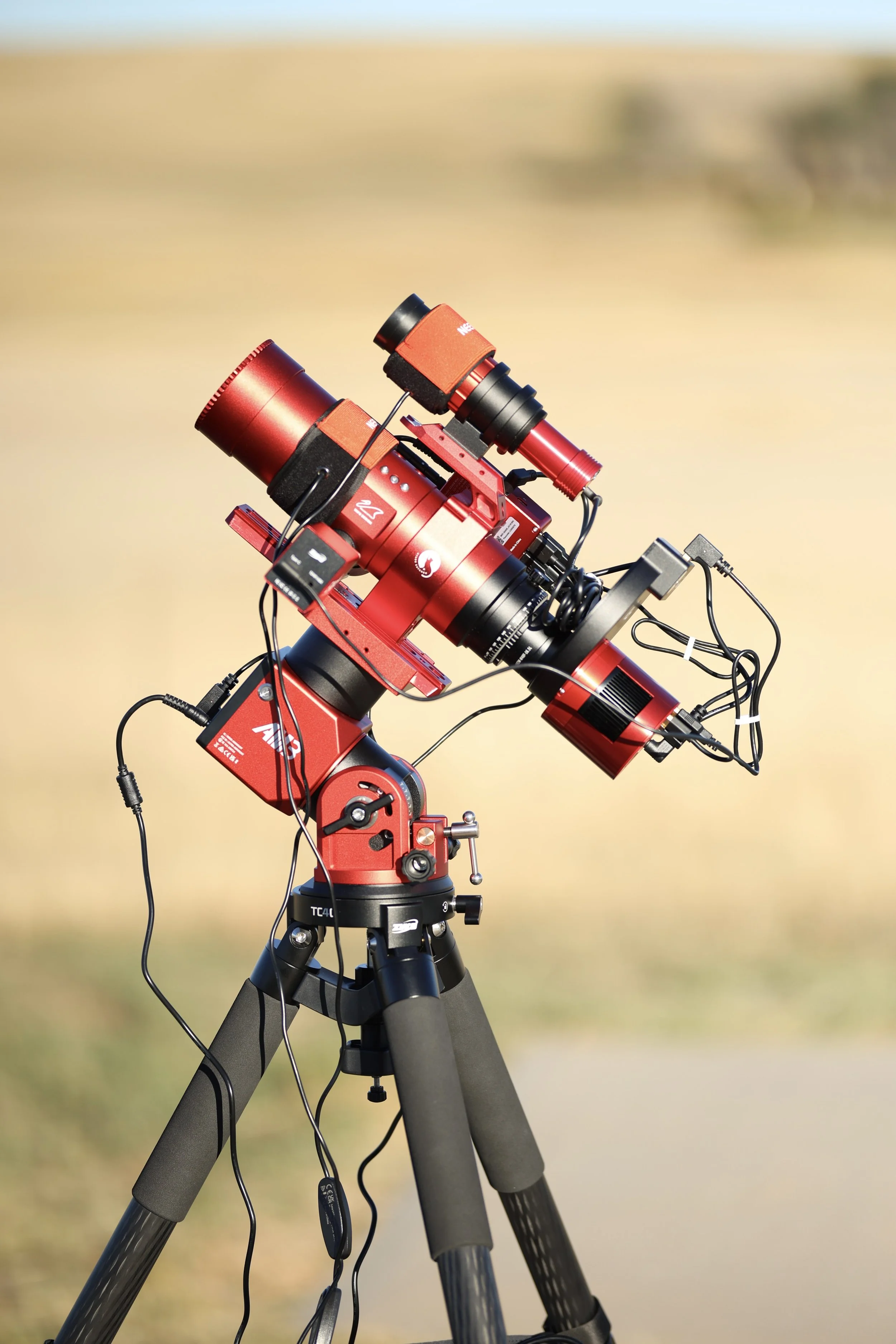
This was the first target I captured with this telescope and one of my first serious astrophotography projects using a dedicated monochrome imaging system. Moving from a one-shot-color Canon camera to a full monochrome setup introduced a substantial learning curve, from acquiring and calibrating individual narrowband channels to combining and processing the data into a coherent final image. Presenting the same dataset in three different palettes also became an opportunity to explore how color can be used not simply for aesthetics, but as a tool for interpreting astronomical structures. The additional complexity, equipment, and processing time proved to be an incredibly worthwhile investment, revealing a level of detail and control that would have been difficult to achieve with my previous OSC setup.
Data were collected from:
- Estes Park - B3/B4
Integration:
Sii: 70×180s (3hr15m)
Ha: 70×180s (3hr15m)
Oiii: 70×180s (3hr15m)
Total: 9hr45m
Equipment:
Telescope: William Optics RedCat51
Camera: ZWO ASI585MM Pro Monochrome CMOS camera
Mount: ZWO AM3
Filters: 7nm Narrowband Sulfur-ii, Hydrogen-Alpha, and Oxygen-iii
Stacked and processed entirely in Pleiades Astrophoto PixInsight