Pelican Nebula
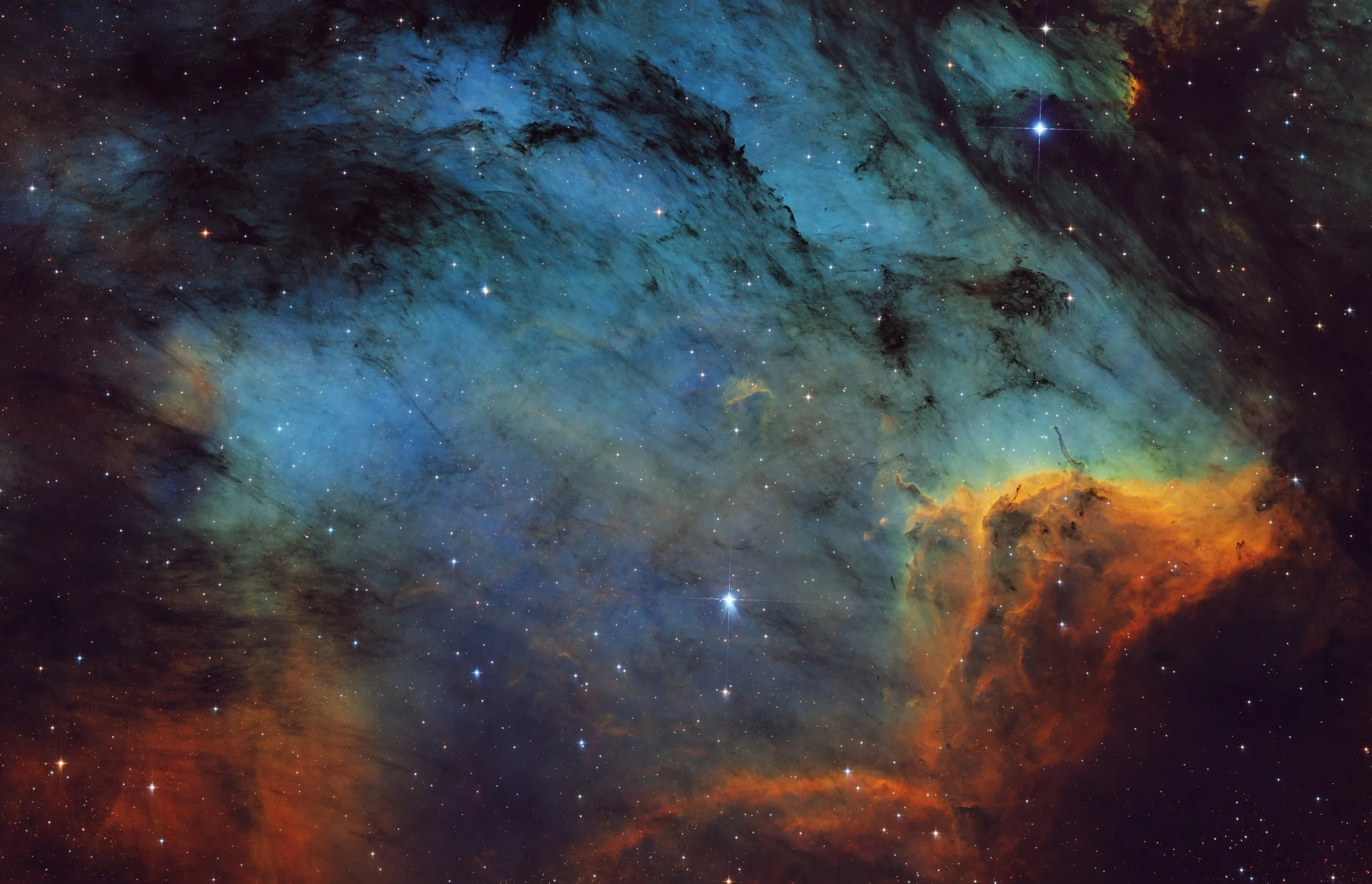
The Pelican Nebula (IC 5070) is a large emission nebula located approximately 1,800 light-years from Earth in the constellation Cygnus. Together with the neighboring North America Nebula (NGC 7000), it forms part of an immense hydrogen cloud spanning more than 100 light-years across. The Pelican Nebula is a prolific star-forming region where intense ultraviolet radiation from nearby young, massive stars ionizes the surrounding gas while simultaneously sculpting the molecular cloud into towering pillars, bright ionization fronts, and dark globules. Within these dense pillars, gravity continues to collapse pockets of gas and dust, giving rise to new generations of stars.
This image is presented in the classic Hubble Palette (SHO) with natural colored broadband RGB stars, where sulfur (SII) emission is mapped to red, hydrogen-alpha (Ha) to green, and oxygen (OIII) to blue. Each emission line traces a different physical environment within the nebula. Hydrogen outlines the extensive ionized gas that permeates the region, sulfur emphasizes the cooler, denser material compressed along the edges of ionization fronts, and oxygen highlights the highest-energy regions nearest the illuminating stars and along shock fronts where stellar winds interact with the surrounding gas. Together, these narrowband emissions reveal the Pelican Nebula as a dynamic, three-dimensional landscape of cavities, ridges, and pillars continuously reshaped by stellar radiation and winds.
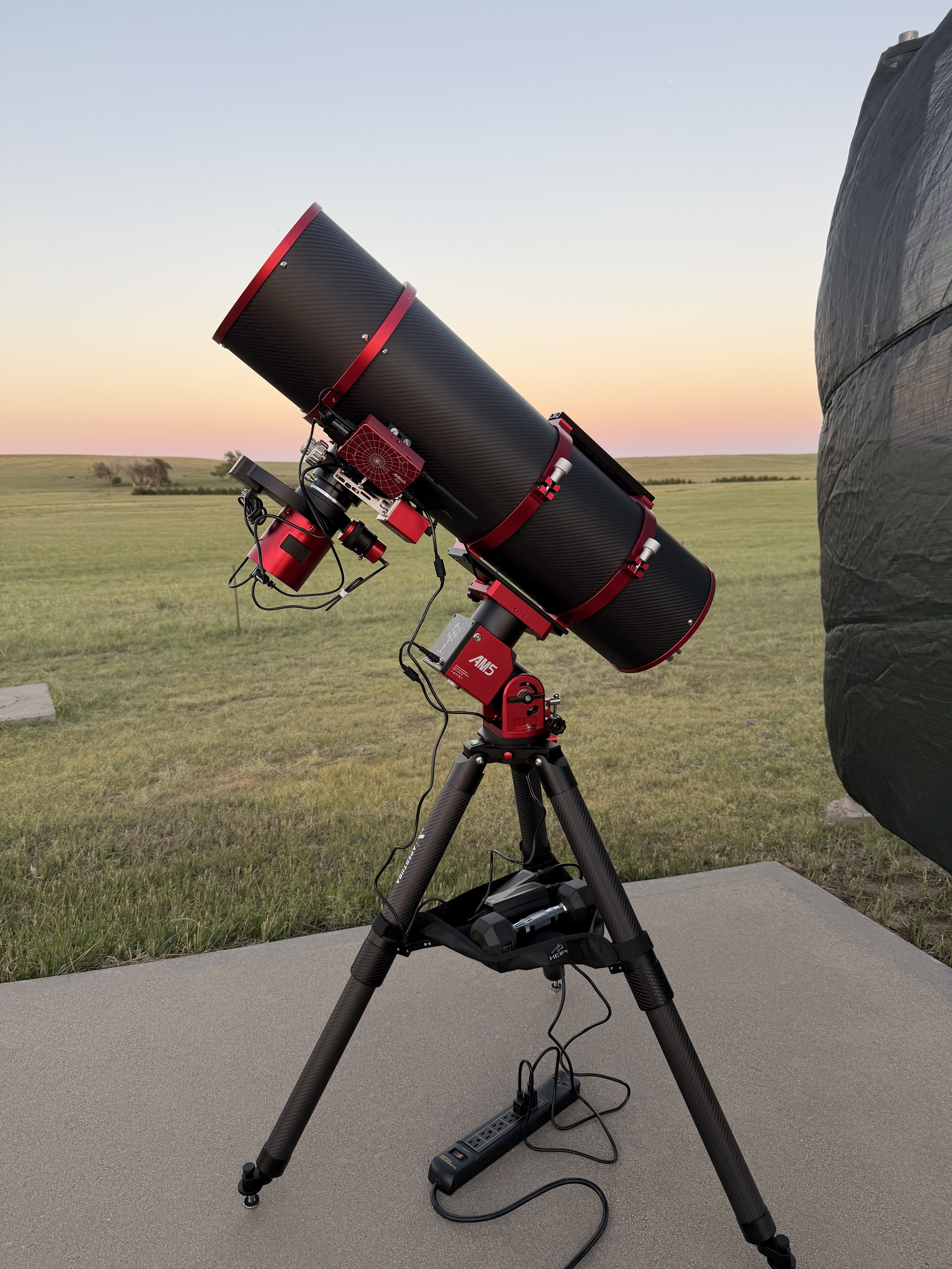
This image was “First Light” with the Apertura CarbonStar200 Imaging Newtonian, an 8-inch Newtonian astrograph using narrowband Antlia RGB and 3nm narrowband SHO filters. The larger diameter objective aperture combined with a longer focal length than the RedCat51 allows you to better resolve the nebula's intricate filamentary structure and fine dust features, revealing the remarkable complexity hidden within one of the Milky Way's most active stellar nurseries.
Data were collected from:
- Boulder - B4/B5
- Kline-Dodge Dark Site (DAS) - B3.
Integration:
R: 30x120" (1hr)
G: 30x120" (1hr)
B: 30x120" (1hr)
S: 56x300" (4h40m)
H: 71x300" (5h55m)
O: 56x300" (4h40m)
Total: 18h15m
Equipment:
Telescope: Apertura CarbonStar200 Imaging Newtonian
Camera: ZWO ASI2600MM Pro Monochrome CMOS camera
Mount: ZWO AM5N
Filters: Broadband Antlia LRGB-V Pro RGB; 3nm Antlia Pro Hydrogen-Alpha, Sulfur II, and Oxygen III
Stacked and processed entirely in Pleiades Astrophoto PixInsight