Heart Nebula
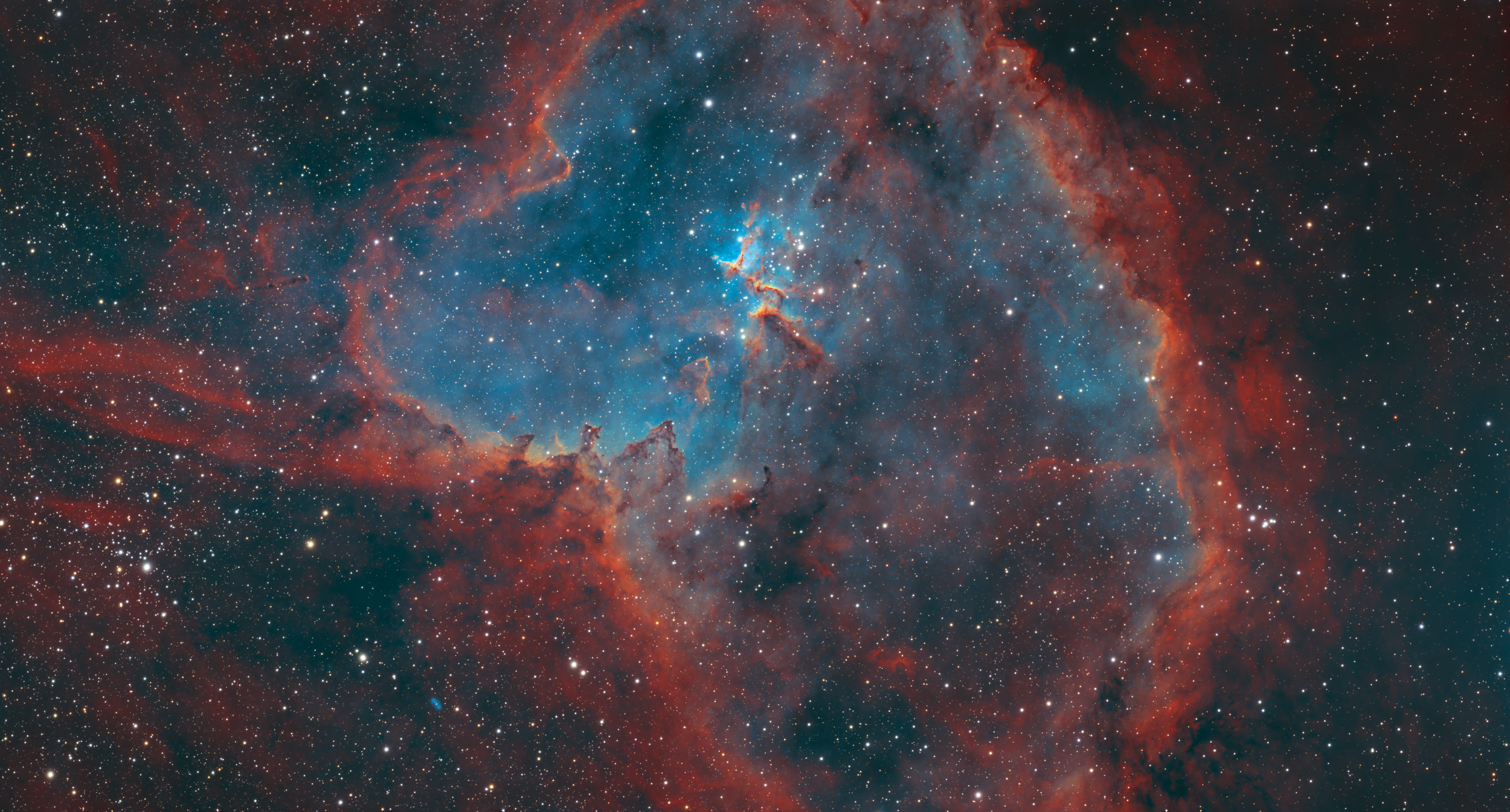
The Heart Nebula (IC 1805) is a vast emission nebula located approximately 7,500 light-years from Earth in the constellation Cassiopeia. Spanning nearly 200 light-years across, it is one of the largest active star-forming regions in the Perseus Arm of the Milky Way. At its center lies the young open cluster Melotte 15, whose massive O-type stars emit intense ultraviolet radiation and powerful stellar winds that ionize the surrounding hydrogen gas while sculpting the nebula into intricate filaments, pillars, cavities, and dark nodules. Within these dense structures, gravity continues to collapse pockets of gas and dust, giving rise to the next generation of stars.
Presented here are two artistic interpretations of the same narrowband dataset, each preserving the underlying scientific information while emphasizing different aspects of the nebula's complex morphology. The first image combines sulfur (SII), hydrogen-alpha (Ha), and oxygen (OIII) emission using a blend of the traditional Hubble Palette (SHO) and the Foraxx palette, with separately acquired RGB stars restoring their natural stellar colors. This approach enhances contrast between the different ionized gases while maintaining a balanced and visually intuitive representation of the nebula's structure.
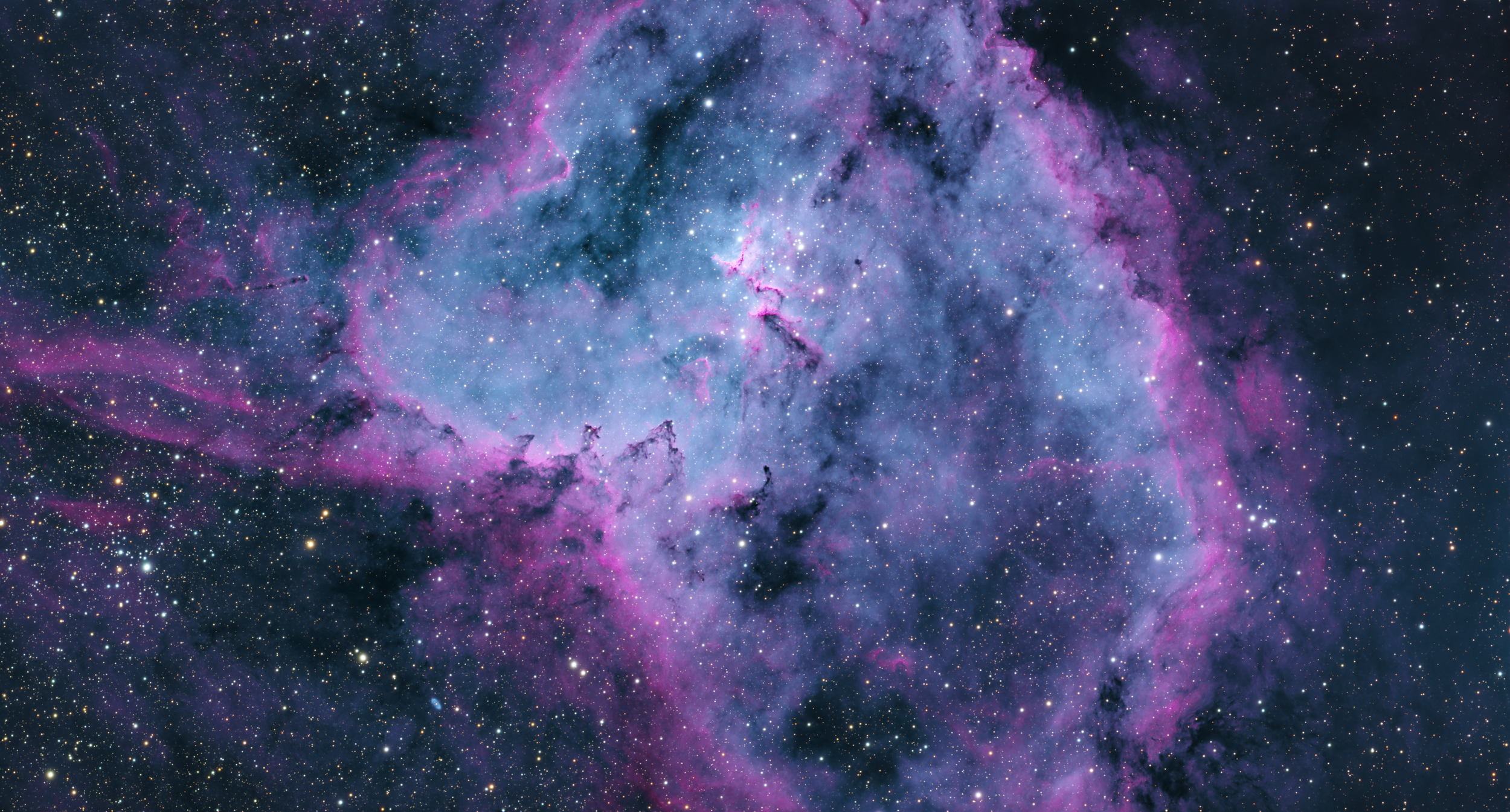
The second image reinterprets the same narrowband data using a custom blue, purple, teal palette with RGB stars. Rather than representing the emission lines with conventional false colors, this palette was intentionally designed to complement the color scheme of the annual fundraising gala hosted by my grade school and high school. With the event's theme, "Out of This World," we felt that showcasing authentic astronomical imagery would provide a fitting centerpiece while maintaining a cohesive visual identity throughout the event. The image was professionally printed, framed, and auctioned as part of the fundraiser, demonstrating how scientific data can be transformed into artwork that is both aesthetically compelling and rooted in real observations of the cosmos.
Data were collected from:
- Boulder - B4/B5
- Kline-Dodge Dark Site (DAS) - B3.
Integration:
R: 30x120s (1hr)
G: 30x120s (1hr)
B: 30x120s (1hr)
Sii: 160×180s (8hr)
Ha: 160×180s (8hr)
Oiii: 160×180s (8hr)
Total: 27hr
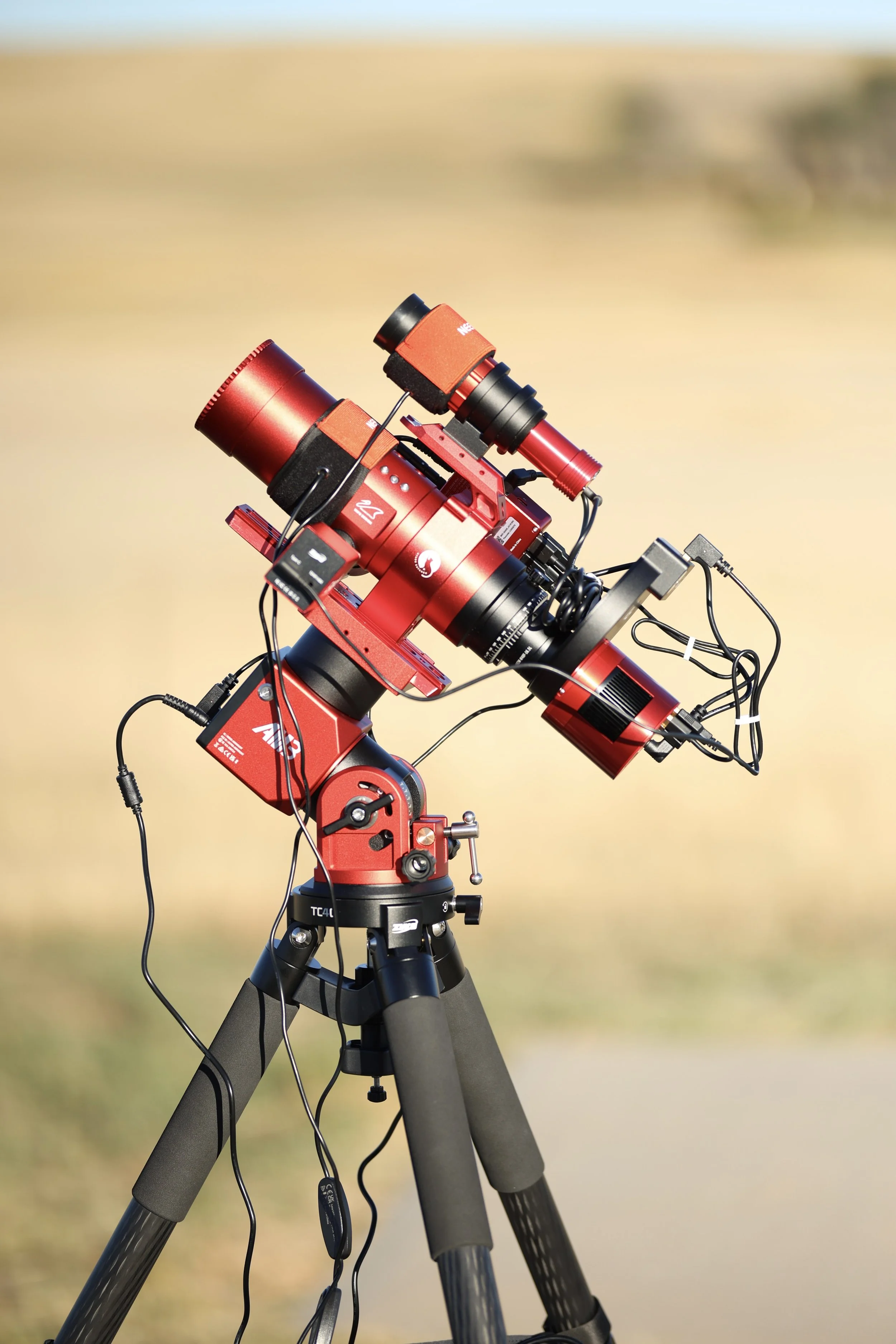
Equipment:
Telescope: William Optics RedCat51
Camera: ZWO ASI585MM Pro Monochrome CMOS camera
Mount: ZWO AM3
Filters: Broadband RGB, 7nm Narrowband Sulfur-ii, Hydrogen-Alpha, and Oxygen-iii
Stacked and processed entirely in Pleiades Astrophoto PixInsight