The Great Orion Nebula — Close Up & Widefield
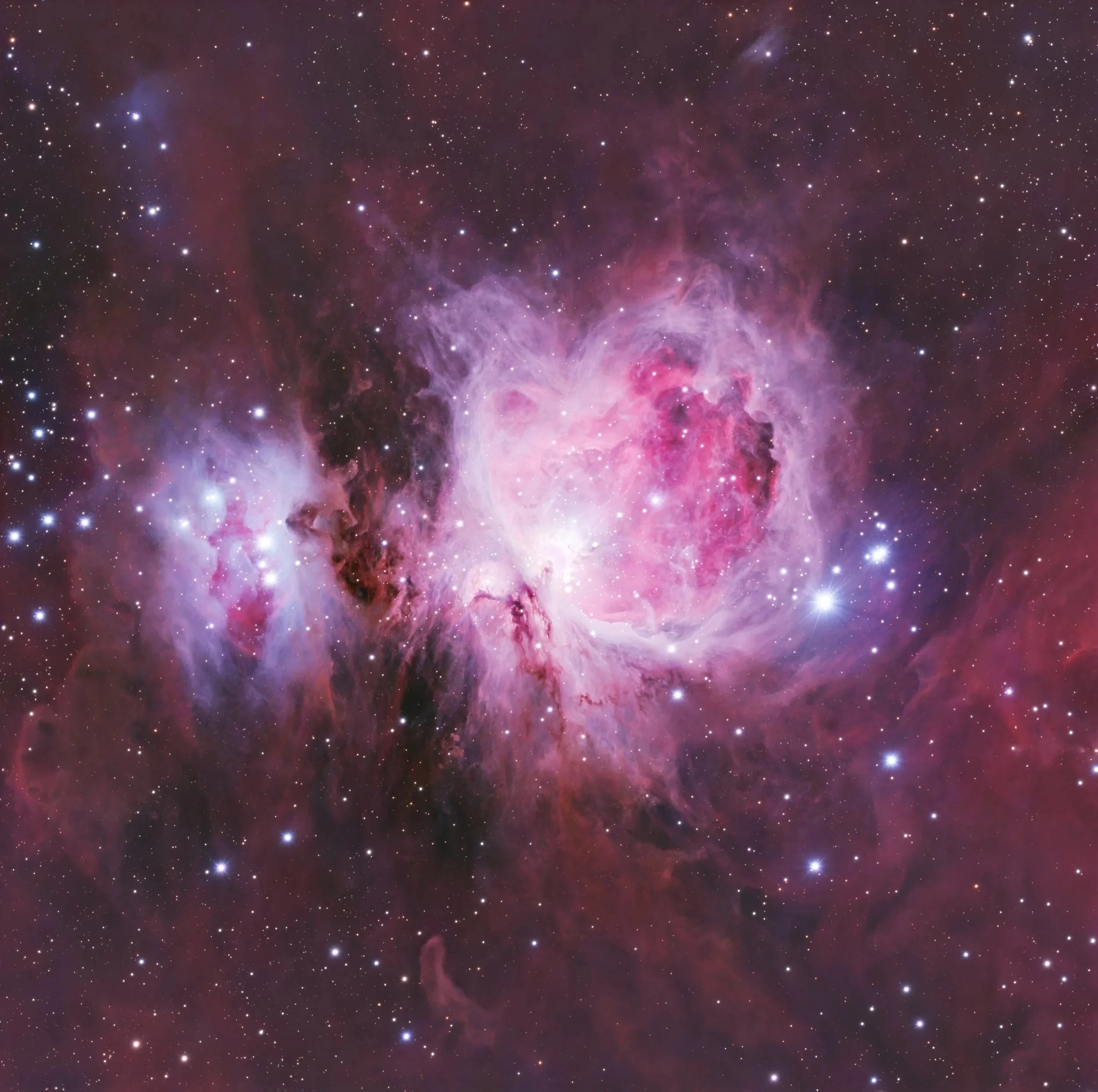
The Orion Nebula (M42) and the neighboring Running Man Nebula (NGC 1977) together form one of the most spectacular and well-studied star-forming regions in the night sky. Located approximately 1,350 light-years from Earth in the constellation Orion, the Orion Nebula is the closest region of massive star formation to Earth and serves as a natural laboratory for understanding how stars and planetary systems are born. At its heart lies the Trapezium Cluster, a group of young, hot O-type stars whose intense ultraviolet radiation ionizes the surrounding hydrogen gas, causing the nebula to glow while simultaneously sculpting the surrounding clouds of gas and dust.
Just north of M42 lies the Running Man Nebula, a reflection nebula illuminated by nearby young stars. Unlike the Orion Nebula, which shines primarily through ionized hydrogen emission, the Running Man glows by scattering starlight from fine interstellar dust. The contrasting emission and reflection processes create the striking juxtaposition of vivid red hydrogen clouds against soft blue dust, revealing two distinct phases of the star formation process within the same giant molecular cloud complex.
For thousands of years, Orion has been one of humanity's most recognizable celestial landmarks. Its bright stars and distinctive belt made it an essential reference for navigation, agriculture, and timekeeping across civilizations including the ancient Egyptians, Babylonians, Greeks, Maya, and many Indigenous cultures worldwide. The constellation's seasonal appearance heralded the changing of the seasons, while its prominent position in the winter sky inspired countless myths, legends, and artistic depictions. Today, Orion continues to serve as a gateway to astronomy for many observers, with the Orion Nebula often becoming the first deep-sky object viewed through a telescope. Modern astronomy has transformed this familiar patch of sky from a cultural icon into one of the most intensively studied regions in the Milky Way, offering an unparalleled window into the processes of stellar birth and the evolution of interstellar clouds.
This image was processed from publicly available broadband RGB data captured with a Rowe-Ackermann Schmidt Astrograph (RASA) 8 telescope and a one-shot color (OSC) astronomical camera. While the original observations were acquired by another astrophotographer and made freely available for educational and non-commercial use, all image calibration, processing, color balancing, noise reduction, and final presentation were completed independently as an exercise in astronomical image processing.
Data were collected from:
- Unknown
Integration:
Total: Unknown, likely 10-15hr
Equipment:
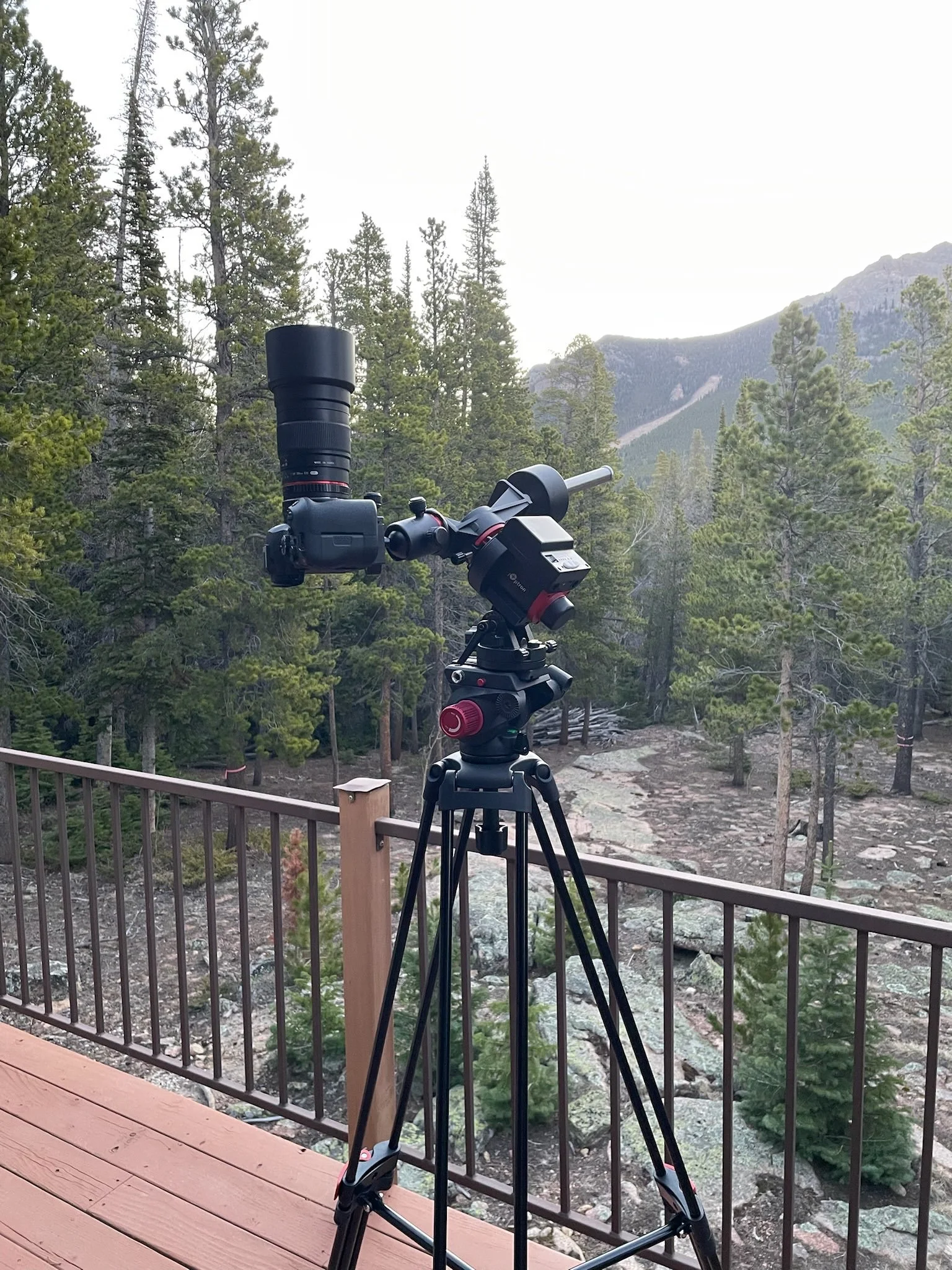
Telescope: Rowe-Ackermann Schmidt Astrograph (RASA) 8
Camera: ZWO ASI533MC Pro Monochrome CMOS camera
Mount: Unknown
Processed entirely in Pleiades Astrophoto PixInsight
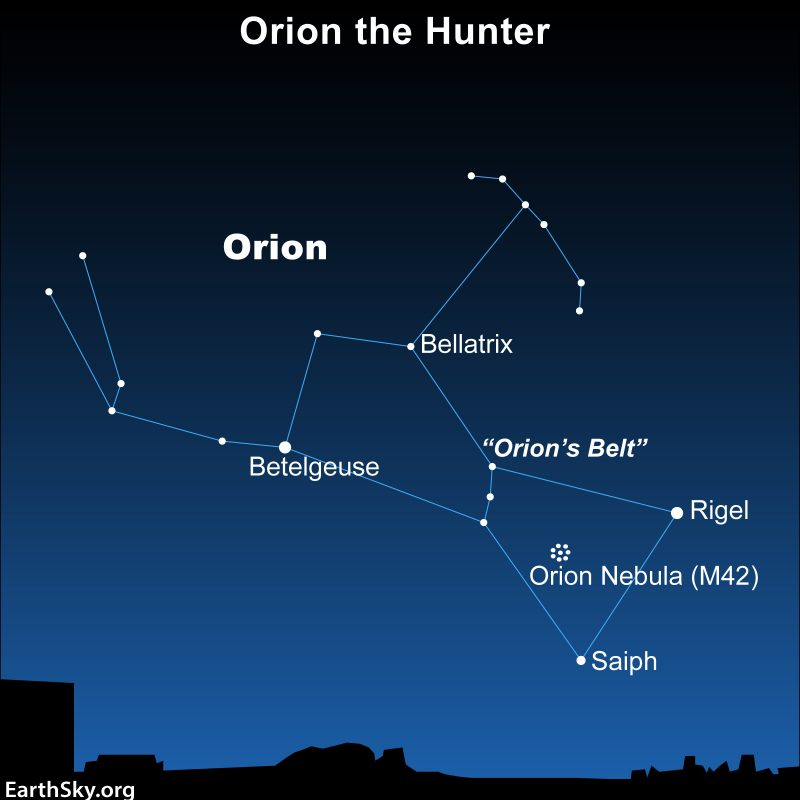
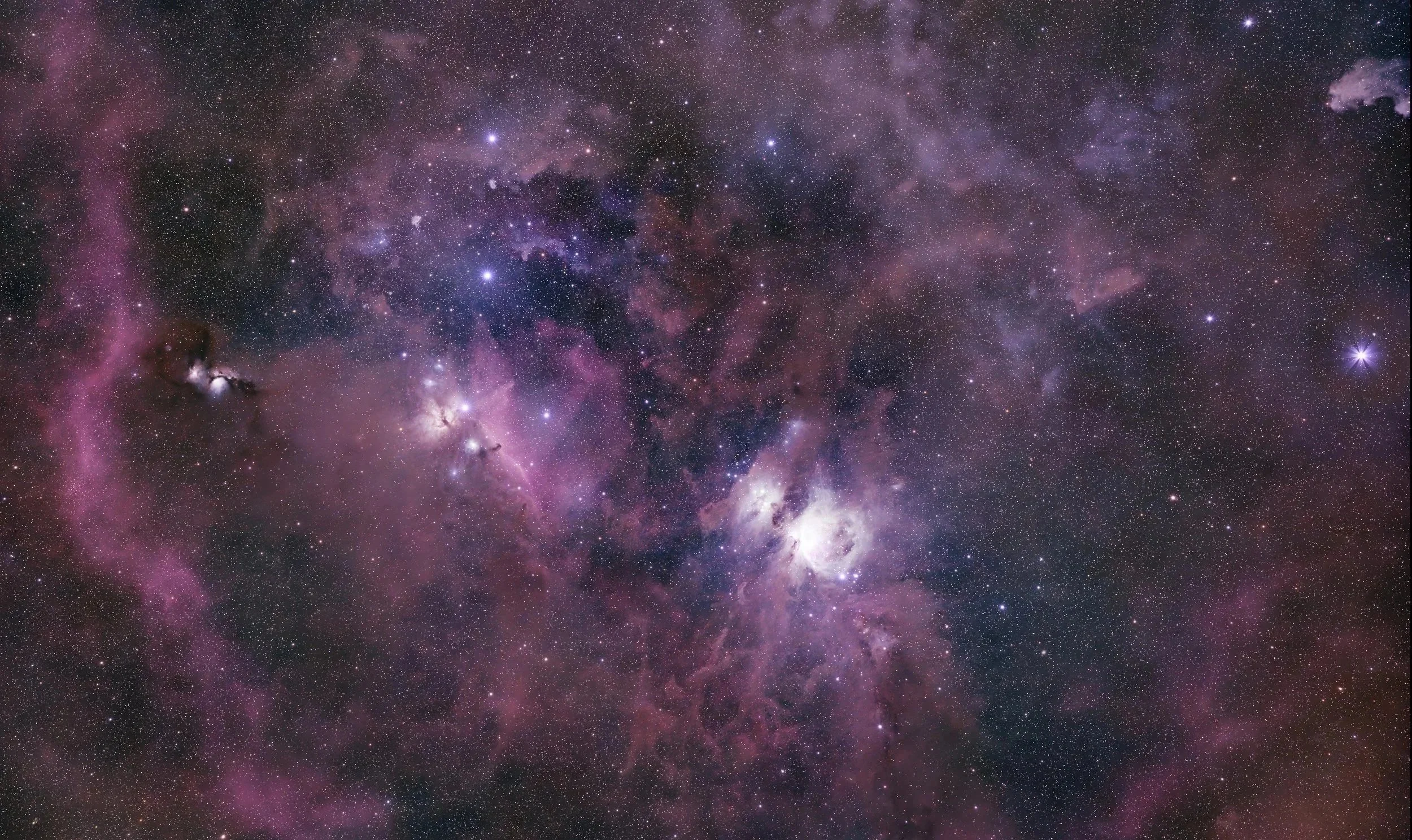
This wide-field view of the constellation Orion captures one of the richest regions of the winter sky, revealing an extraordinary variety of deep-sky objects embedded within a vast complex of gas and dust approximately 1,300–1,500 light-years from Earth. Dominating the center of the image are Orion's iconic Belt stars, Alnitak, Alnilam, and Mintaka, which have guided observers for millennia. Hanging beneath the Belt is the brilliant Orion Nebula (M42) and its northern companion, the Running Man Nebula (NGC 1977), both active stellar nurseries where new generations of stars continue to emerge from collapsing molecular clouds.
Along the eastern edge of Orion's Belt, the Horsehead Nebula (Barnard 33) appears as a dark silhouette against the glowing hydrogen emission of IC 434, while the neighboring Flame Nebula (NGC 2024) surrounds Alnitak with intricate lanes of obscuring dust illuminated by the star's intense radiation. Farther north, the reflection nebula M78 shines with the characteristic blue light of dust scattering nearby starlight. Stretching across the image is a faint arc of Barnard's Loop, an enormous hydrogen emission shell spanning hundreds of light-years, likely produced by ancient supernova explosions and powerful stellar winds within the Orion Molecular Cloud Complex.
The brilliant blue-white supergiant Rigel anchors the lower portion of the constellation (right), while the faint Witch Head Nebula (IC 2118) can be seen just entering the edge of the frame. Illuminated by Rigel's light, this expansive reflection nebula is composed of interstellar dust sculpted by stellar radiation. Beyond these well-known objects, delicate streams of molecular cloud dust weave throughout the image, appearing as dark filaments and faint reflection nebulosity. These cold, dense clouds contain the raw material for future generations of stars, illustrating that the familiar stars of Orion are only the brightest features within a much larger and remarkably active star-forming complex.
Data were collected from:
- Kline-Dodge Dark Site (DAS): B3
Integration:
Total: 4hr
Equipment:
Telescope: Rokinon 135mm F/2 EF lens
Camera: Canon EOS R6 Mark II, stock — no astro modification
Mount: IOptron SkyGuider-Pro Right Ascension Manual Star Tracker.
Filters: None, captured in natural true color OSC broadband
Processed entirely in Pleiades Astrophoto PixInsight